
OUT OF EGYPT
For Egyptian-born Jews, the current crisis elicits a mix of emotions—from nostalgia for an idyllic existence under the monarchy to the terror of being chased out to calls of ‘kill the Jews’
By Paula Sadok
February 9, 2011 • 7:00 AM


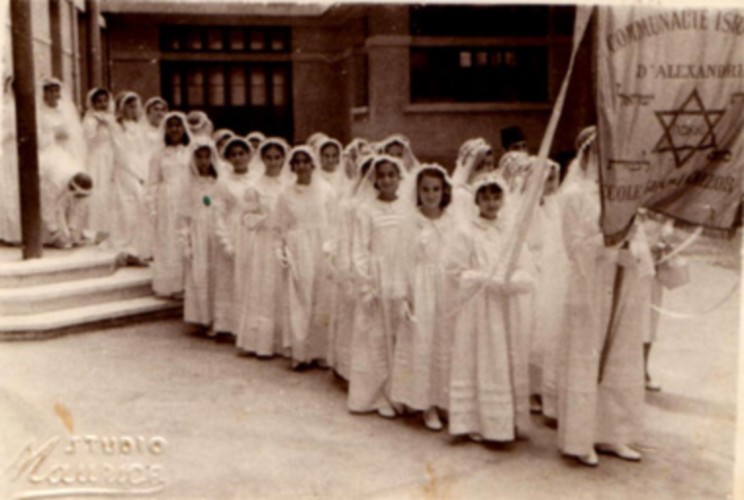
 A group bat mitzvah in Alexandria. (Nebi Daniel Association)
On a Saturday night in late January 1952, Sidney Miraz and his family gathered in his uncle’s apartment in Heliopolis, a suburb of Cairo. Then, as now, angry crowds swarmed the streets demanding the removal of Egypt’s leaders. Though his parents tried to keep him away from the window, Miraz, a young boy, could see a large blaze glowing in the sunset. The commercial district of Cairo was engulfed in flames. An uncle who lived in the city called every 15 minutes, updating the terrified family.
Miraz, now 68 and living in San Diego, is one of the many Jews watching the current crisis in Egypt with a sense of déjà vu. Before the creation of Israel in 1948, the Jewish community in Egypt boasted 80,000 members. In three waves of immigration—after the 1948 war, after the Suez Crisis in 1956, and after the SixDay War in 1967—the community has dwindled to its current population of fewer than 40.
Fragments of Jewish manuscripts in the Cairo Geniza, a depository for religious books found in the Ben Ezra synagogue in Old Cairo, date Egypt’s Jewish community back at least 2000 years. In the 12th century, Maimonides and his family fled Spain and settled in Egypt. Centuries later, Jews escaping the Spanish Inquisition found a haven along the Nile. In the late 19th century, the opening of the Suez Canal provided Jews with irresistible economic opportunity as they flocked to Cairo and Alexandria from Europe and the Ottoman Empire.

The upper echelon lived well in pre1952 Cairo, or the “Paris on the Nile,” as it was called. Residents marveled at the city’s cleanliness, the rich aroma of French perfumes emanating from department stores stocked with European goods, the trees lining the streets heavy with fragrant mangoes and tangerines. Jews thrived. They founded the banks, hospitals, major department stores, contributing
to every aspect of Egypt’s modernization. The monarchy sent a delegation to the main synagogues on High Holidays as a sign of respect and solidarity.
Viviane Franco, now 62 and living on Long Island, wrote in an email that the current protests have brought back terrifying memories of her childhood, like the times she was forced to hide in her family’s Cairo apartment, shutters closed, listening to people on the streets chant idbahu elYehud— “Let’s kill the Jews.” Franco’s family immigrated to Naples in the aftermath of the SixDay War, when she was 18. She has little faith in the current protesters, saying that they are trying to “hoodwink the Americans into thinking Egyptians want democracy.” And she claims that numbness, not terror, is the lasting result of her childhood. “When I heard about the riots,” she wrote, “I didn’t even cry because I felt nothing.”
Miraz’s reaction is seemingly more measured on the surface, but equally pessimistic. “As a Jew who grew up in an Arab country, I know firsthand that Islam can be tolerant and kind to others,” he wrote from Israel, “as long as they are inferior or weak—dhimmi—in their group.”
Other Egyptianborn Jews expressed concern for the fate of the synagogues and Jewish cemeteries, as well as the Torah scrolls and religious articles.
Ita Lezmi, an octogenarian born in Alexandria, has lived in Brooklyn for decades. “Jews were lucky to be in Egypt,” she says. She says her childhood was an idyllic existence, calling life under the British administered monarchy “sweet, easy, beautiful and magnificent.” Lezmi realizes that such a life came at great cost to others, and she says that the lower class has suffered greatly under Mubarak. “Here’s the situation,” she says. “They’re starving. Mubarak doesn’t give the poor a chance to breathe.” She was one of the few people I spoke with who was hopeful about the country’s future. “Look at this beautiful new generation, how the students stood to protect the museum, the schools, the hospitals. They’re educated. They want freedom.”
Lezmi and her family were expelled from Egypt after the Suez War; her husband was a French national. The family was given 24 hours to leave. “They took the house,” she says. “They took everything.” The Lezmis went to Genoa, Italy, where they “lived like dogs,” she said, before continuing for America.
Desire Sakkal, president of the Historical Society of the Jews from Egypt, based in Brooklyn, was 2 years old during the 1952 revolution and remembers little. But the terror that followed the Suez War remains clear to him. His grandfather, Halfon Safdieh, who would later be chief rabbi of the Egyptian
community in Brooklyn, and his uncle, Solomon Safdieh, were beaten in the streets. His father was summoned to the local police department several times on the charge of being a Zionist. Still Sakkal’s father wanted to stay. In 1962, the government confiscated the family’s prosperous business, a button factory. The family fled, living in France for several months before settling in New York.
On one point everyone I spoke to agreed: No matter how much they suffered after being forced out of their homeland, they were happy they were no longer in Egypt.
“When you leave, you are still suffering,” Sakkal says. “But in the long run, it’s a blessing.”
“What kind of life would we have in Egypt? What would we do?” Lezmi wonders. “Thank God for America.”
CORRECTION, February 9: The Sakkals left Egypt in 1962 after their button factory was confiscated, not in 1967. This error has been corrected.
February 15: Sidney Miraz left Israel for France in 1980 and now lives in San Diego. This error has been corrected.


COMMENT


MORE IN: ALEXANDRIA CAIRO CAIRO GENIZA DESIRE SAKKAL EGYPT

EGYPTIAN JEWRY ITAA LEZMI MAIMONIDES MOSHE MARZOUK NASSER SIDNEY MIRAZ THE CRISIS IN EGYPT YOSEF MARZOUK




United States Middle East World